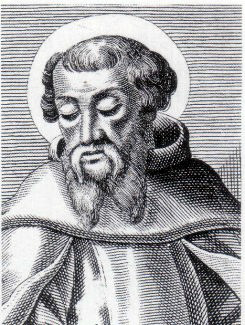
I guess I was most intrigued by the free use of mixed metaphors and parables. No strictly literal interpretation of the the Bible here! And this by a second century great Christian leader, the bishop of Lugdunum (love that name!) in Gaul, which is present-day Lyons in France, who was a disciple of St. Polycarp, bishop of Smyrna, present-day Izmir in Turkey on the other side of the Mediterranean, who was in turn a disciple of St. John the Evangelist. To me it's fascinating to see how freely a writer, just a couple of generations removed from the apostles, makes use of the traditions of the Gospels.If we are not be scorched and made unfruitful, we need the dew of God. Since we have our accuser, we need an Advocate as well. And so the Lord in his pity for man, who had fallen into the hands of brigands, having himself bound up his woulds and left for his care two coins bearing the royal image, entrusted him to the Holy Spirit. Now, through the Spirit, the image and inscription of the Father and the Son have been given to us, and it is our duty to use the coin committed to our charge and make it yield a rich profit for the Lord.
Sunday, May 23, 2010
St. Irenaeus at Pentecost
This morning, praying today's "Office of Readings" (for Pentecost Sunday), I was deeply impressed by the following passage from St. Irenaeus' "Against Heresies":


Sunday, April 11, 2010
Celebrating Divine Mercy Sunday on Pilgrimage.

A few of us, representing all of you, are traveling through Turkey visiting a land made holy by a history of great Christian saints, and is now a modern secular republic that is 99% Muslim. Our Early Christian World Pilgrimage explores all facets of our heritage and our experience both as Christians and as men and women living in our world today. In establishing Divine Mercy Sunday ten years ago, Pope John Paul II emphasized that, in Christ, God's mercy expends to all people, without exception.
In a society and culture where that vast majority of people do not believe as we do -- and I'm speaking about the USA as well as Turkey -- our role is not to proselytize and convert, but to bear witness. To let our actions as well as our words speak, faithfully and clearly, out of our own experience of the mercy and love of God. And that's what this feast is all about. To seek a deeper trust and dependence on God's overwhelming mercy, which we can claim because of our Savior, Jesus Christ.
Yesterday (Saturday) we visited Troy and Gallipoli , both sites of famous battles -- one brutal and ancient, the other brutal and modern -- and we pray for peace in our troubled world. Today we go to Pergamon, site of a famous Hellenistic center for healing, as well as place of the "throne of Satan" mentioned in the book of Revelation (Rev. 2:13), and pray that we all maybe faithful in living the call of Christ to give witness to our faith by works of service. Midweek we will be in Ephesus, the ancient city graced by both St. Paul and St. John, and we will celebrate Mass at the house of the Blessed Virgin Mary, a shrine that is equally revered by both Christians and devout Muslims. We pray in a special way that Mary, loved in both religious traditions, may intercede to bring understanding and reconciliation among peoples.
The end of the week will find us in the Lycus Valley, the site of three cities -- Hierapolis, Laodicea, and Colossae -- whose Christian communities had a special relationship to St. Paul (see his letter to the Colossians and to Philemon). A week from today, next Sunday, after Mass at the tiny church of St. Paul and Thecla downtown, we'll visit the tomb of the great Sufi mystic, Rumi, who founded the Whirling Dervishes. Then we will spend time exploring Çatalhöyük, excavations of a 9,000-year-old neolithic settlement. We seek to discover the surprising hand of God even in ancient human history.
Sunday, April 4, 2010
Easter andTurkey

Christ is risen, Alleluia! He has truly risen, Alleluia!
All Orthodox Christians throughout the world, as well as Catholics who follow "Eastern Rite" liturgies and traditions but are in union with the Church of Rome, greet one another with those words during the Easter season. The first sentence is the greeting by one person; the second sentence is the response by the other.
Sure beats "Hi, how are ya?", doesn't it?
If you want to look further into this, Wikipedia lists the variants of this greeting in dozens of languages worldwide at http://en.wikipedia.org/wiki/
So what does this have to do with Turkey, a secular republic that is more than 99% Muslim? Muslims recognize Jesus as a prophet, the greatest of the prophets before Muhammad. They even recognize his virgin birth from Mary. (In fact, Mary is mentioned more times in the Koran than she is the New Testament.) But they do not believe in his divinity, in his Resurrection, nor that he is the Son of God.
Accurate statistics are difficult to come by, but best estimates of the non-Muslim population are about 35,000 Catholics, 80,000 Orthodox (of which there are many varieties), 5,000 Protestants, and 26,000 Jews. (The majority of Jews in Turkey are Sephardic, descendants of those expelled from Spain in 1492.)
Behind these numbers lies an extensive, multifaceted history that, like any history of peoples and cultures, has glorious and tragic elements intermingled. Unfortunately, the history that most of us have learned in our American education, including Catholic church history, is heavily biased toward Euro-centrism, ignoring or downplaying both the intrinsic value of other cultures and the significance of their contribution to what we now are pleased to call "Western Civilization."
Frankly, I have come very late in life to realize and understand this. I became interested in this significant and neglected part of our heritage, including the 2,000-year contribution of Eastern Christianity as well as the 1,300-year contribution of Islam and Muslim culture, only as a result of my first visit to Turkey in 2000, exactly 10 years ago. I too was thoroughly indoctrinated in Euro-centrism for the first 57 years of my life. My own cultural awakening has broadened and deepened my understanding of our heritage as Catholic Christians and its implication for our life here and now in today's world. This isn't limited to history or cultural anthropology alone. My life-long interest in theology, scripture, and liturgy has been re-oriented as well. (Don't forget that the etymology of the word "orientation" means "facing east.) Out of this has been born my passion to share, as widely as I can, understanding of this heritage. And that's why I see leading this Early Christian world Pilgrimage to Turkey every year as a central part of my ministry even as pastor of a parish.
Why Turkey? Christianity, including Catholic Christianity, grew up in the land we now call Turkey. Even before Rome could claim its role as the sole center of "Catholic" Christianity, the Christian church was a collaborative diversity of churches. There are undoubtedly more sites in Turkey, made holy by significant holy people and events, than anywhere else in the world, including Rome and Israel/Palestine. With good reason I often call Turkey "the other Holy Land." Sadly, East and West grew increasingly alienated from one another, until the (thus far) irrevocable split occurred in 1054 with an angry and tragic mutual excommunication. This mutual excommunication was formally nullified in 1965 by Pope Paul VI and Ecumenical Patriarch Athenagoras I. There has been serious contact and dialogue since then, but any real, formal unity remains elusive.
More often than not, for a variety of historical reasons, the Orthodox celebrate Easter several weeks after we do in the West. This year, however, it's the same. On Thursday and Friday this week (April 8-9), our Early Christian World Pilgrims will be visiting several historic Orthodox churches in Istanbul (formerly Constantinople), and will see those churches still decked out in their Easter finery. We will be praying for you at all the holy places in this land, dear to the heritage of both Catholic and Orthodox Christians. And we ask that you pray for us during the coming weeks of our Pilgrimage. You can follow us on the Pilgrimage at http://ecwpilgrimage.org.
Christ is risen, Alleluia! He has truly risen, Alleluia!
Sunday, March 28, 2010
Where would/did Jesus stand?
I've just finished reading Fr. Greg Boyle's Tattoos on the Heart. It's a powerful book, and, once started, very hard to put down. Here is a man who has put his life -- humbly, firmly, and imperfectly -- where his mouth is.
"Mouth" calls to mind the great, divisive polarization that has so gripped our country, our Church, and our world. I don't believe that God's going to punish the world because of pro-choice abortion policies nor for racist anti-immigrant attitudes and policies, both of which are morally reprehensible if we take Jesus' teachings seriously. God's going to punish us by simply letting our own unwillingness to find common ground with those we disagree with to reach its logical and inevitable conclusion: self-destructive polarization. Armed camps bent on mutual destruction.
I like Greg Boyle's take on this. He doesn't try to "philosophize" as much as I do, and so his straightforward simplicity is very appealing. I'm going to quote at length, hoping I'll be forgiven a potential copyright transgression by promoting sale of a few copies. (Check it out on Amazon.com, and be sure to watch the video on that page.)
If you're not familiar with Homeboy Industries, check out their website. Perhaps even get a "virtual carwash." I did.
"Mouth" calls to mind the great, divisive polarization that has so gripped our country, our Church, and our world. I don't believe that God's going to punish the world because of pro-choice abortion policies nor for racist anti-immigrant attitudes and policies, both of which are morally reprehensible if we take Jesus' teachings seriously. God's going to punish us by simply letting our own unwillingness to find common ground with those we disagree with to reach its logical and inevitable conclusion: self-destructive polarization. Armed camps bent on mutual destruction.
I like Greg Boyle's take on this. He doesn't try to "philosophize" as much as I do, and so his straightforward simplicity is very appealing. I'm going to quote at length, hoping I'll be forgiven a potential copyright transgression by promoting sale of a few copies. (Check it out on Amazon.com, and be sure to watch the video on that page.)
Success and failure, ultimately, have little to do with living the gospel. Jesus just stood with outcasts until they were welcomed or until he was crucified--whichever came first.For my part, I know I have to keep calling myself back to the understanding, which I preach so often, that God doesn't want our success, God wants our fidelity. God grants success in God's own way, not as we humans like to measure it.
The American poet Jack Gilbert writes, "The pregnant heart is driven in hopes that are the wrong size for this world." The strategy and stance of Jesus was consistent in that it was always out of step with the world. Jesus defied all the categories upon which the world insisted: good-evil, success-failure, pure-impure. Surely, He was an equal-opportunity "pisser-offer" in this regard. The right wing would stare at Him and question where He chose to stand. They hated that He aligned Himself with the unclean, those outside--those folks you ought neither to touch nor be near. He hobnobbed with the leper, shared table fellowship with the sinner, and rendered Himself ritually impure in the process. They found it offensive that, to boot, Jesus had no regard for their wedge issues, their constitutional amendments or their culture wars.
The Left was equally annoyed. they wanted to see the ten-point plan, the revolution in high gear, the toppling of sinful social structures. They were impatient with His brand of solidarity. They wanted to see Him taking the right stand on issues, not just standing in the right place.
But Jesus just stood with the outcast. The Left screamed: "Don't just stand there, do something." And the Right maintained: "Don't stand with those folks at all." Both sides, seeing Jesus as the wrong size for this world, came to their own reasons for wanting Him dead. (pp. 172-173)
If you're not familiar with Homeboy Industries, check out their website. Perhaps even get a "virtual carwash." I did.
Parish Director of Administration Search
(Note: this was the "Pastor's Reflection" for the Good Shepherd Parish Bulletin, March 28, 1010.)
What does it mean for a pastor to "run a parish"?
I think the expectation -- conscious or unconscious -- most people have is that the pastor is (or should be) omnicompetent and omnipotent -- makes all the decisions and carries them out flawlessly and to everyone's satisfaction, including, of course, God's.
That's not the real world anywhere else, nor is it in the Church.
After my first nine months as your pastor of watching and listening, as well as reflecting, consulting, and praying, I am launching a search for a parish Director of Administration. This will be the person who will directly manage all business, financial, and organizational aspects of the parish, including supervision of staff and facilities. There is currently no one, except the pastor, who has real responsibility and authority in all these areas. It's impossible for one human being to try to maintain sole control in a situation like this, and crazy-making to even try. I need a partner who will serve essentially as my right hand -- parish COO, if you will -- in all the management responsibilities involved in running the parish.
That will free me to be, well, a pastor. Like I was ordained to do.
Our current business consultant, Bill Vondrasek, is chairing a search committee which will recruit applicants, review resumes, and interview the strongest potential candidates. Bill will be joined by Barbara Gunning, Bill Gould, and Rob Weiler, who are members of either the parish Pastoral Council or the Finance Council. Rounding out the committee will be Mary Jean Neault, who served as Director of Administration in my previous parish, and is currently Director of Pastoral Ministries there. Nobody knows "the field" as well as she does.
I hope by the first week of May, when I return from the Early Christian World Pilgrimage in Turkey, they will be able to present several top candidates for me to interview and make the final selection.
In addition to a full complement of administrative and managerial skills, this person must have knowledge and experience in how the Catholic parish works, both as institution and as community. This means prior experience in Church administration is a requirement.
The position opening is being publicized among a rather specialized target audience throughout the Archdiocese of Los Angeles, but anyone who believes himself or herself qualified is welcome to apply. The salary will be commensurate with Archdiocesan scale, taking into account the person's qualifications. If you know anyone who may be qualified and interested, encourage them to send a resume and a written letter of interest to Bill Vondrasek, in care of the Good Shepherd Parish Office, 504 N. Roxbury Dr., Beverly Hills, 90210.
Please offer a prayer or two that the right person will surface who can effectively partner with me to serve the parish community well in this vital role.
God bless you always. I love you.
Sunday, March 21, 2010
Come with us on the Pilgrimage
(Note: this was the "Pastor's Reflection" for the Good Shepherd Parish Bulletin, March 21, 2010)
These days, as we prepare to celebrate the mysteries of our redemption, the Passion-Death-Resurrection of our Lord Jesus Christ (the Paschal Mystery), I am also preparing to leave the day after Easter on the Early Christian World Pilgrimage to Turkey.
This will be the fourth such Pilgrimage I've led in the weeks following Easter. For many reasons -- spiritual, practical and aesthetic -- that's the only time to go. Even the inconvenience of the timing is a part of the grace: true Pilgrimage, after all, does involve hardship too.
Transformation is at the heart of the Paschal Mystery, and at the heart of Pilgrimage. Our Early Christian World Pilgrims of past year almost unanimously describe it as a "life-changing experience."
I'm always aware that the majority of people simply cannot come on this kind of journey, and there are many valid reasons for this. I have always felt compelled to try to share the benefits of the Pilgrimage as widely as possible. That's one reason why meetings to study and prepare have always be open to anyone. I have found that studying and praying with the ancient men and women of great wisdom we encounter while walking through history has enriched my own understanding and life of faith as a Catholic, and many of these insights find their way into my homilies. I've also been able to share bits and pieces of the Pilgrimage experience in videos I've uploaded to YouTube. There's also a lot of wonderful resources on the internet that enable anyone to gain much by virtually making the journey.
This year, I hope to be able to intentionally and systematically include you -- all of you who may want to come along virtually and have access to the internet on a computer. We are a small group of Pilgrims, only eleven plus me. That means we can all participate in sharing with you. This will probably take written form as well as pictures and video. We have a Pilgrimage website at http://ecwpilgrimage.org which will serve as a portal for all the resources we can put online. We also have an "Early Christian World Pilgrimage" Facebook Group. Join and you can make this an interactive experience, posting comments and discussion along the way. These are wonderful technological resources, and they can serve to help and enhance our faith in ways undreamed of in the past.
I'll be gone the whole month of April and the first few days of May. When the Pilgrimage formally ends on April 28, I'm planning to stay over the weekend in Istanbul. I've never yet had the chance to explore that marvelous city on my own, and I'm really looking forward to that few days of vacation.
"Mystagogia" is the time when newly initiated Christians are invited to explore and study the "Mysteries" of our faith, especially the sacraments. Our Pilgrimage provides the ideal occasion for this kind of exploration; it's really an immersion into our heritage of faith. Come with us, at least virtually and in spirit.
I'm already making plans for next year's Pilgrimage. It will be a little shorter and a bit later -- Easter is quite late next year. It will begin on Wednesday, April 27, 2011, in Istanbul (you have to leave a day or two before that), and will conclude on Saturday, May 14. It seems a long way off, but if you start planning and arranging your schedule now, it may be more possible than if you wait. Think and pray about it.
May these last weeks of Lent be filled with grace for you and all those you love. I love you.
Sunday, March 14, 2010
Lent with the Elect
(Note: this was my "pastor's reflection" in the Good Shepherd Parish Bulletin for March 14, 2010)
Scrutiny.
Now there's a scary word. While I was growing up the word always carried with it a sense of threat, judgment, and impending doom. Like the feeling I got when, as a sixth grader, I had neglected to study for the spelling test.
The American Heritage Dictionary defines scrutiny as "a close, careful examination or study." When I'm trying to figure out the meaning of a word as we uses it today, I always find it helpful to explore the origin of the word. Looking at what how it came to us and how it developed through history reveals nuances of meaning that a mere definition can't express. So where did the word "scrutiny" come from?
First of all, it's from the Latin word scrutari, meaning "to search." So far so good. But behind simple answers there often lurks a telling surprise. That word comes from an earlier word scruta, meaning "trash."
So scrutiny originally means "looking for garbage." No wonder the word is scary. But that understanding enhances rather than diminishes its importance for a those who are sincerely seeking to change and renew their lives during Lent.
The authentic, ancient tradition of the Church never viewed conversion as a merely private matter. Those seeking to become disciples of Jesus Christ do so publicly in communion (fellowship) with the community of believers.
That's why the Second Vatican Council, nearly half a century ago, calling for us today to go back and learn from our origins and heritage, restored the ancient process of Christian Initiation involving a communal journey of growth in faith and life, characterized by well-defined steps and public rites marking transitions from one stage to the next. During Lent, the whole community is invited to join in a spirit of prayer and self-examination with those, now called the Elect, who are on the final leg of their journey to full initiation into the Catholic Church.
Lent, for all of us, is a time of quite literally searching for and getting rid of the garbage of our lives in order to provide hospitality for our Risen Lord who comes to share his life with us.
On the three middle Sundays of Lent we celebrate the Scrutinies with the Elect. These moments of self-searching, illuminated by three very striking Gospel events, are truly joyful because the task at hand is making way for our Savior who is also our eternal Lover.
The Rite of Christian Initiation of Adults (RCIA) tells us the "the Scrutinies are meant to uncover, then heal all that is weak, defective, or sinful in the hearts of the Elect; to bring out, then strengthen all that is upright, strong, and good" (#141). It goes on to say:
And we all do this along with them, gaining inspiration from their dedication and supporting them with our example and prayers. We can always profit from taking difficult things to heart, even the word "scrutiny."
I love you.
Scrutiny.
Now there's a scary word. While I was growing up the word always carried with it a sense of threat, judgment, and impending doom. Like the feeling I got when, as a sixth grader, I had neglected to study for the spelling test.
The American Heritage Dictionary defines scrutiny as "a close, careful examination or study." When I'm trying to figure out the meaning of a word as we uses it today, I always find it helpful to explore the origin of the word. Looking at what how it came to us and how it developed through history reveals nuances of meaning that a mere definition can't express. So where did the word "scrutiny" come from?
First of all, it's from the Latin word scrutari, meaning "to search." So far so good. But behind simple answers there often lurks a telling surprise. That word comes from an earlier word scruta, meaning "trash."
So scrutiny originally means "looking for garbage." No wonder the word is scary. But that understanding enhances rather than diminishes its importance for a those who are sincerely seeking to change and renew their lives during Lent.
The authentic, ancient tradition of the Church never viewed conversion as a merely private matter. Those seeking to become disciples of Jesus Christ do so publicly in communion (fellowship) with the community of believers.
That's why the Second Vatican Council, nearly half a century ago, calling for us today to go back and learn from our origins and heritage, restored the ancient process of Christian Initiation involving a communal journey of growth in faith and life, characterized by well-defined steps and public rites marking transitions from one stage to the next. During Lent, the whole community is invited to join in a spirit of prayer and self-examination with those, now called the Elect, who are on the final leg of their journey to full initiation into the Catholic Church.
Lent, for all of us, is a time of quite literally searching for and getting rid of the garbage of our lives in order to provide hospitality for our Risen Lord who comes to share his life with us.
On the three middle Sundays of Lent we celebrate the Scrutinies with the Elect. These moments of self-searching, illuminated by three very striking Gospel events, are truly joyful because the task at hand is making way for our Savior who is also our eternal Lover.
The Rite of Christian Initiation of Adults (RCIA) tells us the "the Scrutinies are meant to uncover, then heal all that is weak, defective, or sinful in the hearts of the Elect; to bring out, then strengthen all that is upright, strong, and good" (#141). It goes on to say:
First of all, the Elect are instructed gradually about the mystery of sin, from which the whole world and every person longs to be delivered and thus saved from its present and future consequences. Second, their spirit is filled with Christ the Redeemer, who is the living water (Gospel of the Samaritan woman in the First Scrutiny), the light of the world (Gospel of the man born blind in the Second Scrutiny) the resurrection and the life (gospel of Lazarus in the Third Scrutiny). From the first to the final Scrutiny the Elect should progress in their perception of sin and their desire for salvation. (#143)
And we all do this along with them, gaining inspiration from their dedication and supporting them with our example and prayers. We can always profit from taking difficult things to heart, even the word "scrutiny."
I love you.
Subscribe to:
Posts (Atom)

